Who Am I today?: A conversation with Isaias “IC” Cruz
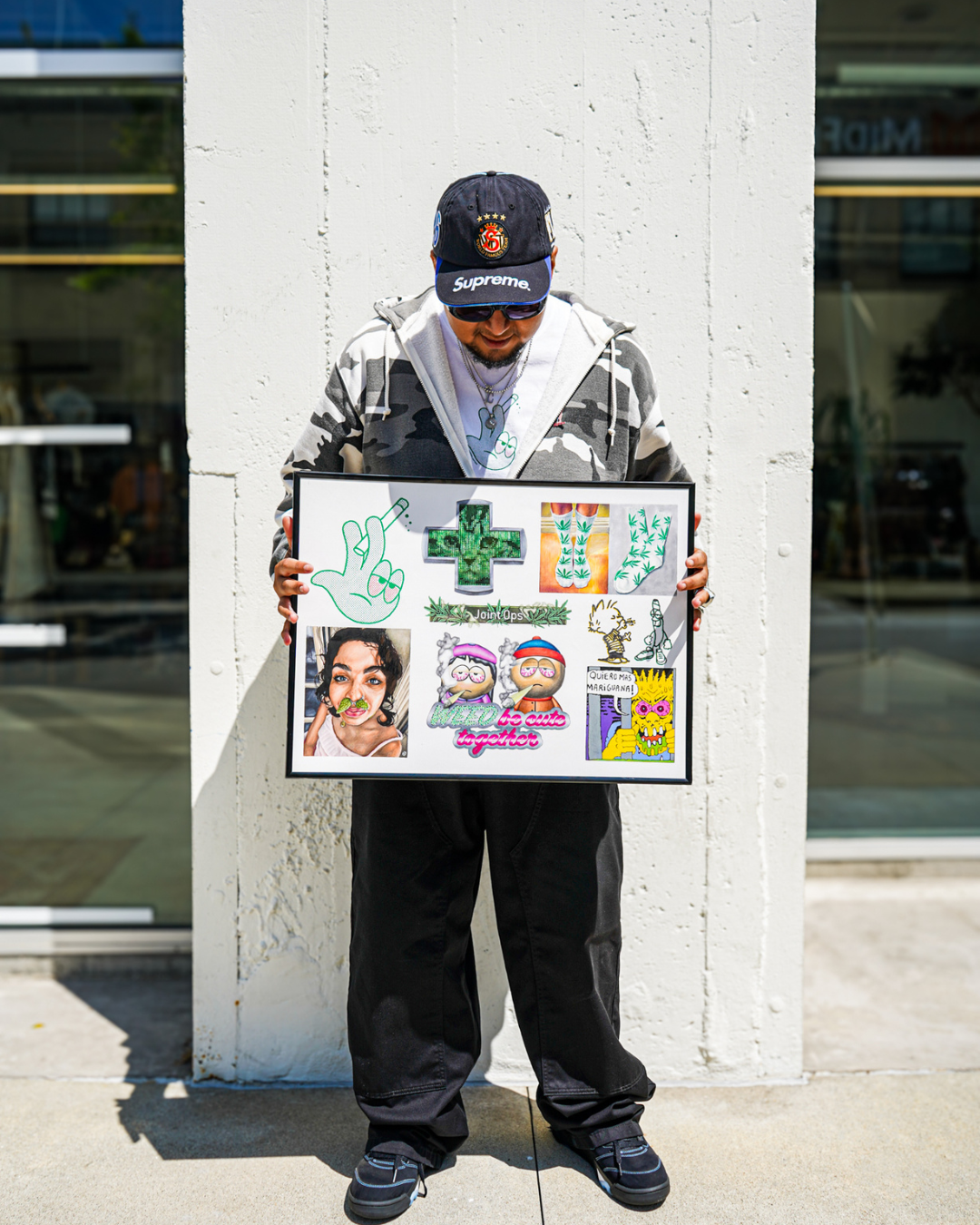
IC posted with da sticker pack 03
Isaias “IC” Cruz is a Los Angeles-based artist who wields a Copic marker like an extension of himself.
He first found inspiration in his craft as a child through public-access television, PBS, and Qubo before graduating to Cartoon Network classics like Chowder, Codename: Kids Next Door, and Regular Show. Those influences still echo throughout his work today.
There’s something comforting about IC’s art. A sense of contemplative stillness. Something so interpersonal that you can see IC through the piece and beyond what is in front of you.
On his website, each of IC’s pieces is accompanied by a short reflection, usually no more than a few dozen words that tie the artwork to a memory or a passing thought.
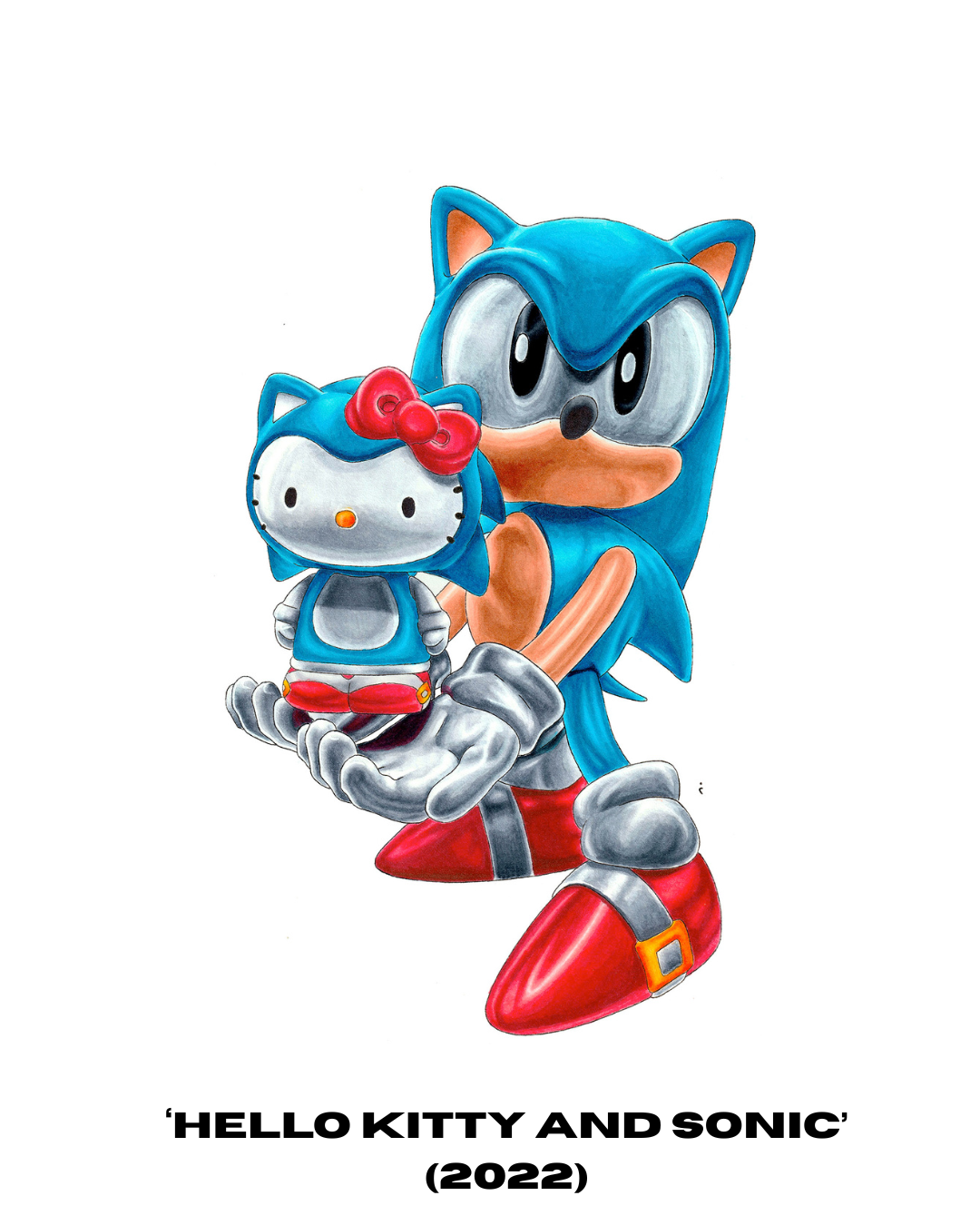
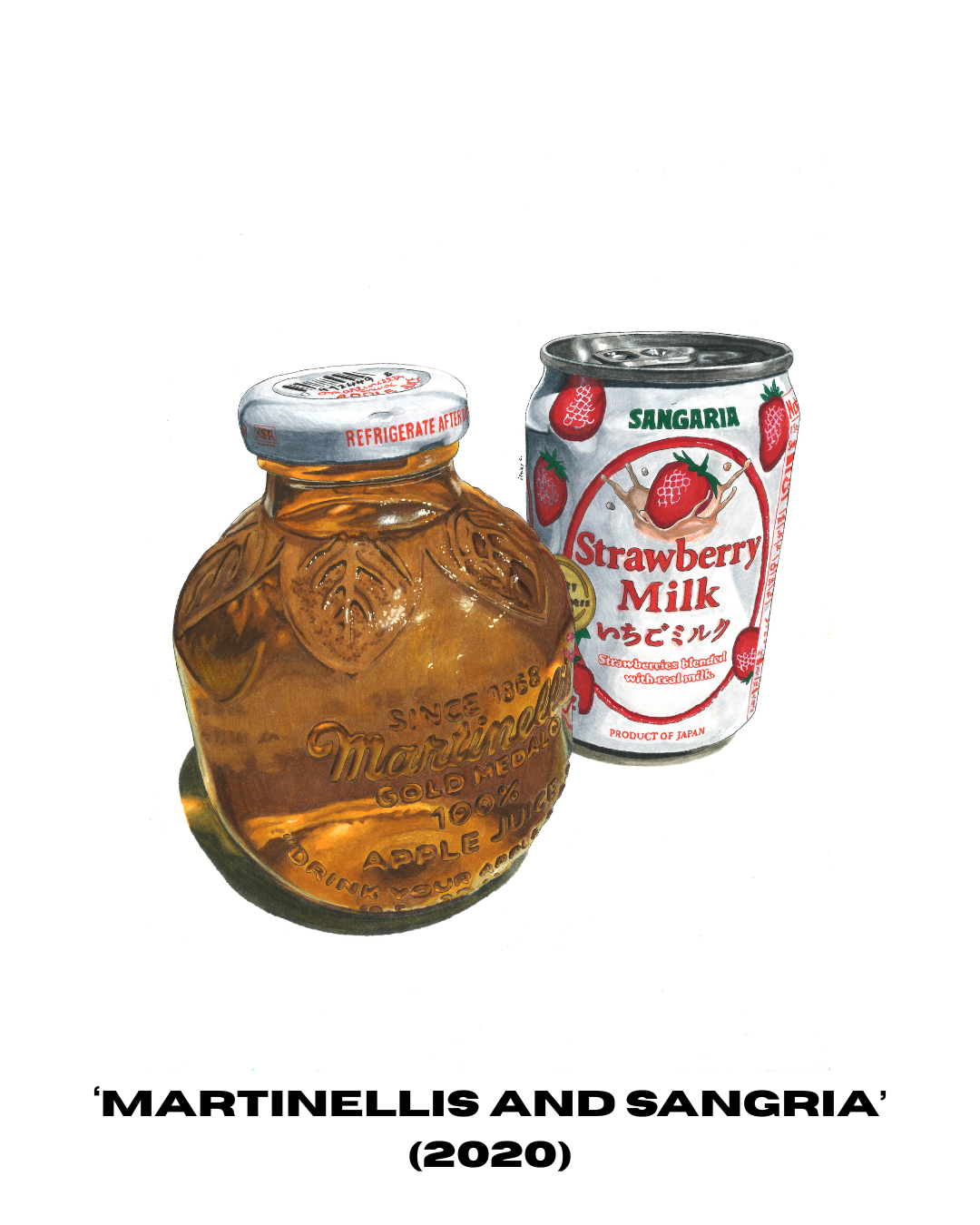
Below his piece, ‘Sonic and Hello Kitty’, he recalls a time he went to see the movie in theaters with friends and saw a man throwing popcorn at security from a bathroom stall. Or under his piece titled ‘bunny girl’, he confides that he didn’t know the popular Sanrio character Cinnamoroll was a dog, which now gives him newfound trust issues. Every sense of IC’s art is to show off some personality, which brings me to his most coveted piece, ‘Martinellis and Sangria’, which became a viral hit on X [Twitter at the time] in 2021. When asked about its virality and how it grew to what it was, IC laughed and said, “I honestly have no idea.”
According to him, he simply wanted to push himself creatively in a way he hadn’t before. The response was just an unexpected byproduct.
When you look at a piece by IC, you're buying into himself as much as you are the artwork.
Personality and character are the crux of IC’s pieces. Echoes of his past and present are embedded throughout his creations.
The collection of his art is him. It's not random; it’s a culmination of tokens, events, his experience, films, shows, hope, and a curation of a life.
This genuineness gleams over everything he makes, giving viewers a sense of familiarity with someone they’ve likely never even met.
IC is creating art that reflects himself. The rest comes later.
read Full Q & a below
Q: Where did you come up with the instagram handle invertcopy? Where did that evolution come from?
IC:
Okay, so for the longest time, my Instagram handle was iceewip, and that kind of went through a couple evolutions just because it’s kind of funny.
I used to spell it out like “icee,” like the slushy drink, but people would pronounce it as “ice.” Given the whole climate right now, I didn’t want that sort of association, so I changed it to icywip.
That kind of had its moment, but I realized the only reason why I changed it to icywip in the first place, way back when, was because at the time, almost every day on my Instagram story, I was posting, “This is what I’m working on,” “Here’s a wip,” “Here’s a wip,” “Here’s a wip.”
But I kind of stopped doing that because I got too busy with school and other things.
So I was trying to figure something out that was a little more fitting, a little more in the moment. I use a lot of Photoshop for editing my work, making graphics, and things like that. In Photoshop, the shortcuts Command + I and Command + C are used for invert and copy.
So I just took those two and made invertcopy. I guess it’s kind of like a military alphabet kind of thing because I tried looking up handles like “India Charlie,” since those are the military alphabet terms for IC, but other people beat me to it.
I felt like taking that approach but adding a graphic design touch to it made more sense. It was something that resonated more with what I actually do.
There were so many other variations too. I was thinking maybe one with an underscore, two underscores, but yeah, they were all gonzo.
Q: How long have you been making art?
IC:
I’ve been making art, I like to tell people, since I could hold a pencil.
Growing up, me and my family didn’t have all the commodities that a lot of people grow up with. I didn’t have cable, barely had internet, barely had a computer that worked.
A lot of my entertainment was just watching public access TV, PBS, and Qubo.
What I would do for fun in my spare time was draw things I saw from TV. I would draw my favorite characters, my favorite shows, and make my own segments from those shows using those characters.
I was kind of just taking all these things from what was immediately accessible to me and putting them into this one world together.
That was all through drawing, making little comics, coming up with silly characters. That was kind of my start.
But if we want to get more professional, I’ve been taking art seriously since around 2018.
That’s when I really threw myself into it. I started investing in good supplies, good quality materials, and really teaching myself.
I would look up tutorials, put my knowledge of color theory together, and just make things happen.
From there, it’s just been continuous growth, experimenting, and learning.
I like to approach every new project as a learning opportunity because even though I’ve been working with the same materials for years, every drawing I work on, I learn a new trick that I can apply with those materials.
I feel like there’s still a lot more that I have to learn, but yeah, it’s been a good eight years that I’ve been going at it.
Q: What were some of your favorite movies, shows, and video games growing up? Give me the specifics.
IC:
A lot of the cartoons I grew up watching were from this public access channel from Canada called Qubo. They weren’t necessarily obscure, but they weren’t shows that a lot of people are familiar with.
One that I still think back on is Jacob Two-Two. It had a really nice illustrator, watercolor kind of approach to its design.
Once we did get cable and I was opened up to that world, Chowder was a great one. Love that show.
Codename: Kids Next Door too.
I feel like when I try coming up with my own characters, I subconsciously think of Kids Next Door with the big heads, big shoes, and that kind of exaggerated style.
A lot of people have come up to me like, “Yo, this reminds me of Kids Next Door,” and I’m like, I guess I didn’t really realize that’s what I was kind of going off of.
But it’s cool to have that influence in the bank.
When it comes to video games, lately a lot of people have been getting into this game, but I remember back in seventh grade I was crazy over it and people just weren’t really feeling it.
It’s cool seeing a new fan base appreciate it now, but it’s Jet Set Radio.
It’s an old Xbox and Dreamcast game. I played both versions.
Q: What was it about Jet Set Radio that connected with you so much?
IC:
If I could pinpoint any sort of media that really pushed me more into the creative realm, I would say it was Jet Set Radio.
I loved the character design. I loved the stage design. I loved the graffiti elements of it.
I remember all of sixth, seventh, and even eighth grade, I was trying to replicate that style of character design and trying my hand at recreating the graffiti from the games.
It was something that was really revealing to me.
It was like, “Wow, this is so creative.”
I didn’t know something like that could really exist in a medium like video games.
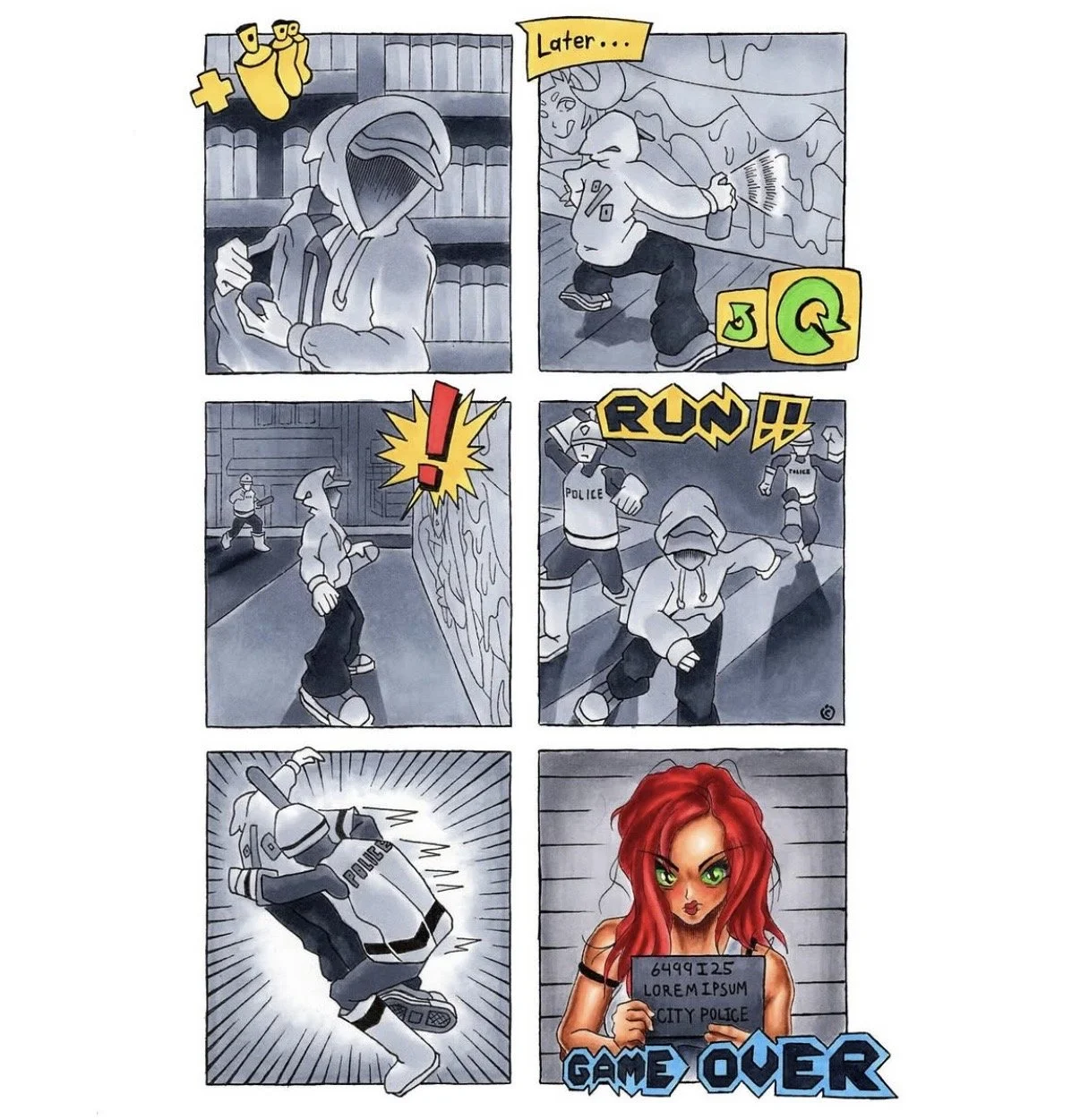
“busted”: Jet Set Radio inspired sequence for CROW MAGAZINE
Q: What about movies? Are there any films that inspire you artistically?
IC:
I’m kind of a mixed bag when it comes to movies.
I like a lot of live-action stuff, a lot of animated stuff. It’s hard for me to say what movies inspire me artistically because I’m not much of a film bro.
But if I had to say a favorite movie of mine, one that I always go back to as a comfort movie, it would be The Big Lebowski.
Back in high school, a friend just started calling me “dude,” and that kind of stuck with me. For a while, I just started going by “The Dude.”
Then another friend was like, “Oh, you just watched The Big Lebowski for the first time and that was your whole thing, huh?”
And I was like, “What is that?”
He’s like, “You don’t know The Big Lebowski?”
I’m like, “Nah.”
So he showed me the movie, and I was like, “Well, I’m already going by The Dude, and there’s a whole movie about a guy that calls himself The Dude. I feel like we kind of have to coexist now.”
But I actually ended up loving the movie.
Every now and then I’ll rewatch it or show it to friends. Some people like it, some people don’t, but it’s definitely a comfort movie of mine.
A lot of my inspiration really comes from cartoons and Cartoon Network.
There was a time where I wanted to work at Cartoon Network, but that was before they got bought out by Discovery.
RIP Cartoon Network, but they’ll always have a special place in my heart.
Q: I’ve noticed a lot of your work revolves around a similar culture and time period. It feels like you’re pulling from a certain era—old cartoons, internet culture, things like that. Are you trying to express what’s personally important to you, or do you think about your work in a broader sense where you’re considering what other people might connect with?
IC:
Really, my approach to a lot of my stuff, especially my more recent work, is just making things that I think are cool or funny.
I’ve been referencing a lot of pop culture, but meme culture is also really big for me. If there’s a trending meme, image, or something that I feel like could highlight a certain theme or emotion, I’ll try incorporating that into the work.
I’ve been working on this series called the Sticker Sheet Collection, where I take a bunch of drawings and images and put them together to kind of tell a story or represent a theme.
My latest one was a 4/20 piece, and I felt like there was so much I could work with when it came to that.
With those, I try implementing pop culture, meme culture, but also throwing in original stuff too, just to keep it true to myself.
To answer the question, I kind of just go based off what relates to me, whether it’s emotionally, something I’m currently into, or something that matches my mood at the time.
I try showcasing that through my work.
People thinking it’s cool is sort of a bonus.
I never really go into it trying to please a crowd, but if people happen to enjoy it, then that’s always cool too.
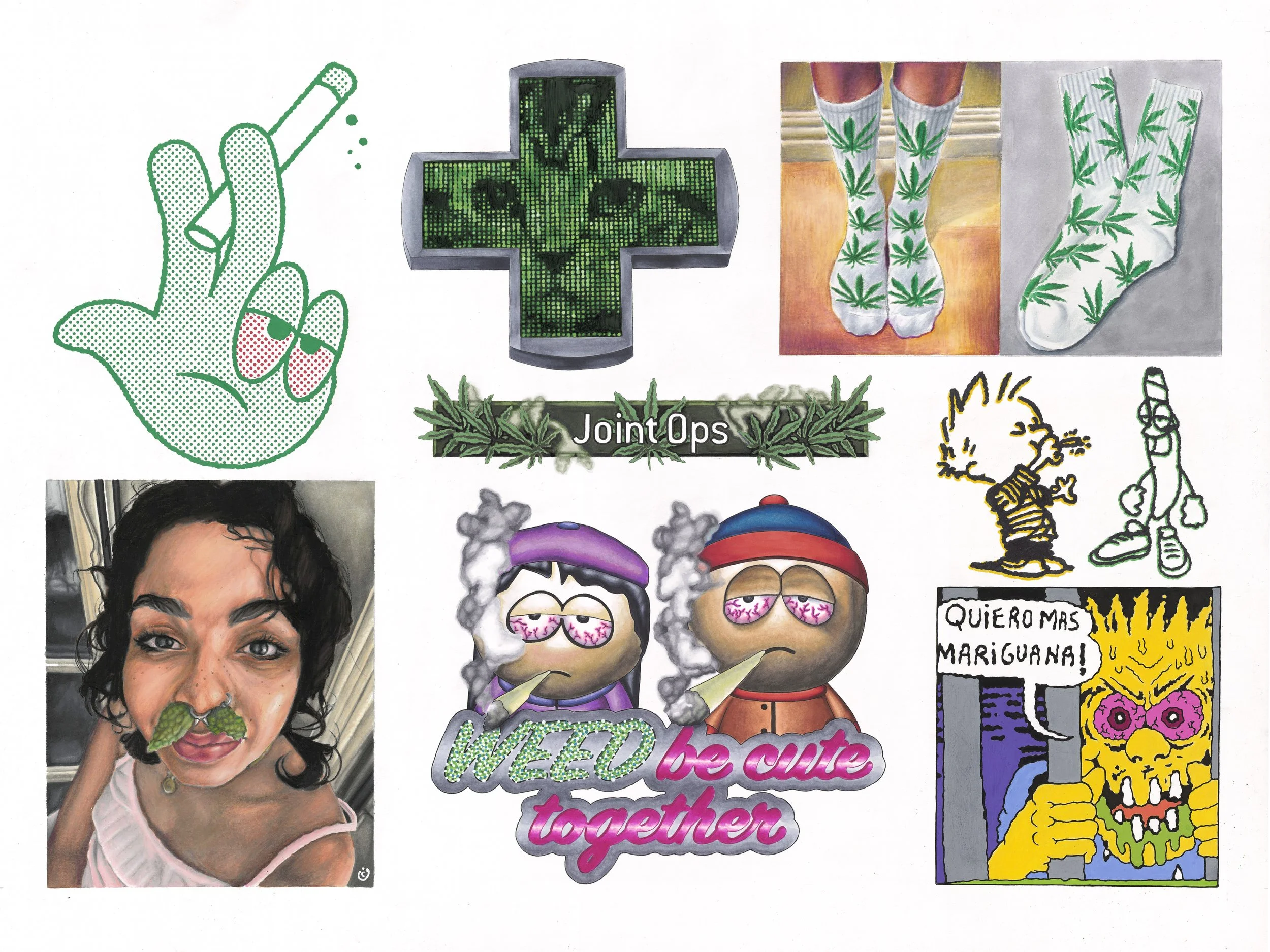
Sticker Sheet 03: The 420 Pack
Q: From the outside looking in, it seems like your work has been received really positively. You don’t really seem to have many people criticizing it. Do you ever think about that?
IC:
I’m blessed to have a good friend group, and that kind of snowballs into an audience online that’s pretty receptive of my work.
They enjoy looking at it. They enjoy sharing it.
For the most part, I try to be as cool of a person as I can be. I just try to be cool with everybody.
It’s only occasionally where I’ll clash heads with someone, but that’s usually more on personal grounds.
When it comes to the art itself, it gets a good amount of love. It hardly gets any hate, really.
But I feel like I need more haters because, you know what they say, you know you’re doing something right if people are hating on it.
But for the most part, I’m glad with how my work is received.
I’m glad people like seeing what I post and are open to seeing me experiment with new things.
That’s part of the reason why I like doing what I do.
It’s like, wow, people actually enjoy seeing my work.
I never thought I’d have any sort of following, really.
So I think it’s cool that people can appreciate it, enjoy it, share it, and even buy it.
It’s a blessing.
Q: Do you ever wish people were more critical? Not in the sense of saying “this sucks,” but more in the sense of giving honest feedback? Do you ever wish people were more blunt with you?
IC:
Yeah, yeah, I honestly do kind of want that.
I wouldn’t say I fiend for it, but I do seek it because I feel like that’s really the only way that artists—or really anyone—can improve and get better.
As someone who spent a long time going through art school and sitting through art critiques, a lot of the time my classmates would talk bad about certain professors.
They’d be like, “Oh, this guy is just talking shit about my work. He’s just a hater. He doesn’t know what’s good.”
But I always saw it differently.
I wouldn’t say they’re hating. They’re trying to help you improve.
You just have to be open to taking that advice and running with it.
I love it when people can come up to me and give me proper criticism.
Like, “Hey, here’s what you can do to make this better.”
“Maybe try something completely different.”
“Maybe change this.”
“Maybe approach it this way.”
I appreciate when someone can give me solid feedback.
I also like giving my fair share of feedback too.
Sometimes it can come off a little harsh, but ultimately I have people’s best interests in mind.
As an artist, I want to see other artists thriving and getting better at their craft.
It’s just a matter of how they receive it.
On my end, it’s never hate. It’s always love. I’m just trying to help people improve.
I feel like we have a lot of hype men, a lot of yes men, that will just kind of egg you on.
They’ll be like, “Yeah, this is good, this is cool, oh, this is sick.”
And while I appreciate that, there are times where I’m like, “But what can I do to be better?”
And they’re like, “Nah dude, this is already sick as fuck. You don’t gotta do anything.”
In the moment, it’s cool. Like, “Wow, I appreciate it.”
But then it’s also like, I feel like I could be better.
I want to be better.
So I’m always looking for feedback that can help elevate me to the next level.

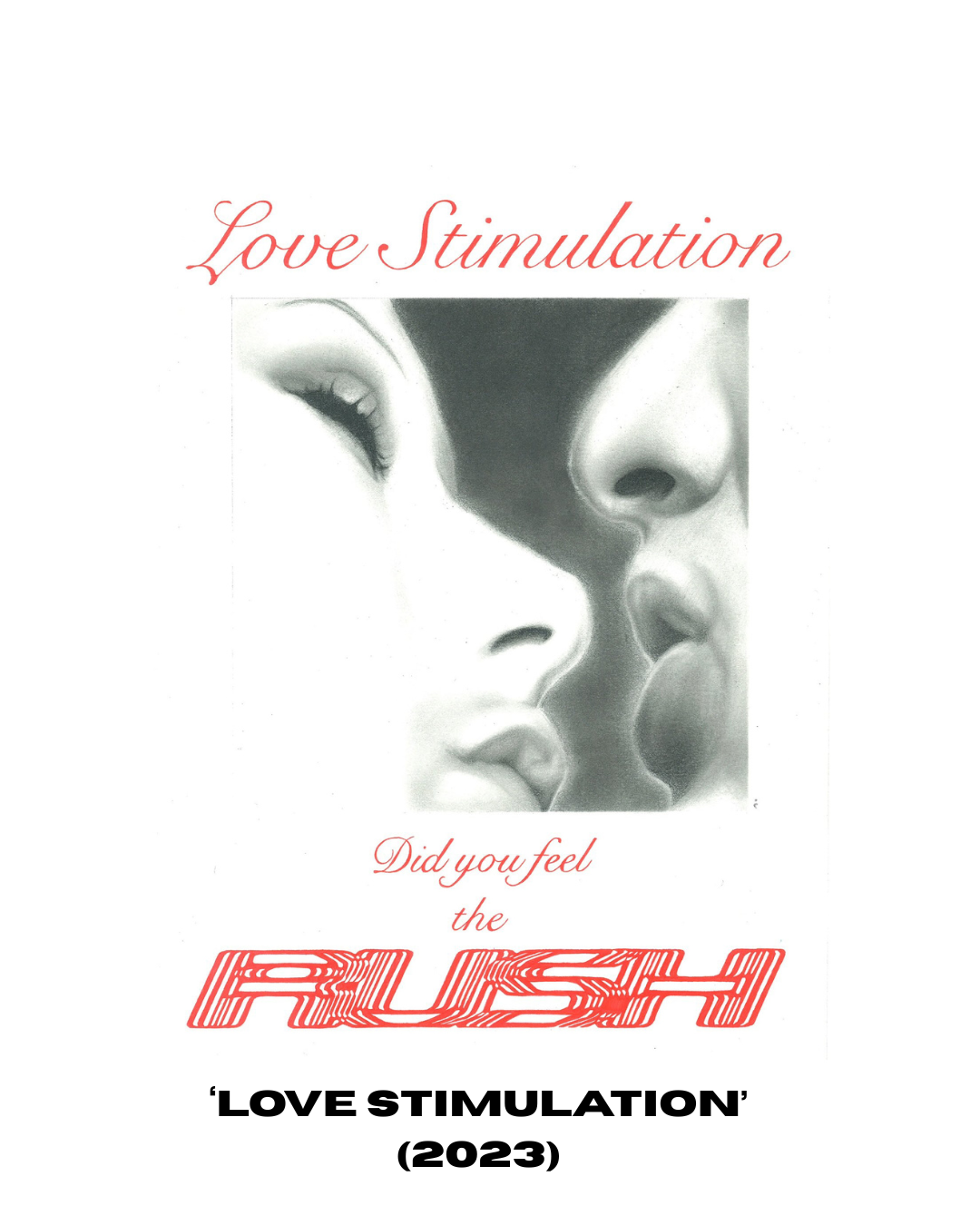
Q: One aspect of your website that I really enjoy is the writing underneath each piece. They almost read like text messages or journal entries. They add another layer to the artwork. Where did that idea come from?
IC:
Honestly, I have to give a shoutout to Palace because that’s where I got the inspiration from.
On their website, you’ll go to a product listing and it’ll just be these little blips that talk about anything except what you’re looking at.
I wanted to take a similar approach with my website.
Also, I appreciate you going as far as looking through it. I feel like a lot of people don’t really go that far when looking into my work.
So I appreciate that.
For some of them, I’m just thinking about something I had in mind while working on the piece.
Maybe it’s a prominent thought that I had during the process.
Then, just for the sake of throwing something out of the blue, I’ll have a memory that resonates with the subject.
So, like you brought up the Sonic one.
The drawing itself was just because I thought it was cute.
A friend got me a Hello Kitty Sonic blind box, and I got lucky enough to pull Hello Kitty in the Sonic costume.
So I made a drawing of that along with this Sonic figure that holds your phone that I used to have.
I was like, “This is cool.”
I love Sonic, so I made it into kind of like a still life—just something for practice and something fun.
When I put it on my website, I was trying to think, “What’s something I could write about?”
Then I thought about Sonic, Sonic 2, and it brought me back to when I watched it in San Francisco with some homies.
That’s a true story.
After the screening, I had to use the restroom, and there was some guy going crazy. Security was trying to get him out of the stall.
As I was walking out to wash my hands, I looked through the mirror and just saw popcorn flying from behind the stall.
I was like, “What is going on?”
It was crazy.
So that’s a really vivid memory I have, and I thought it would be funny to include that in the description because it’s something I personally connect with the piece.
Other ones are just tongue-in-cheek jokes.
Sometimes I’ll complain about something going on in my personal life and be like, “Oh yeah, by the way, here’s this drawing that has nothing to do with what I’m talking about.”
It’s just a little personal touch.
Something to show more personality and character because I try putting that into the art, but sometimes it doesn’t come across.
You don’t really get much of my personality from looking at a drawing of a Sonic figure.
So I feel like adding that extra element on the website is a perfect way to showcase more of my personality.
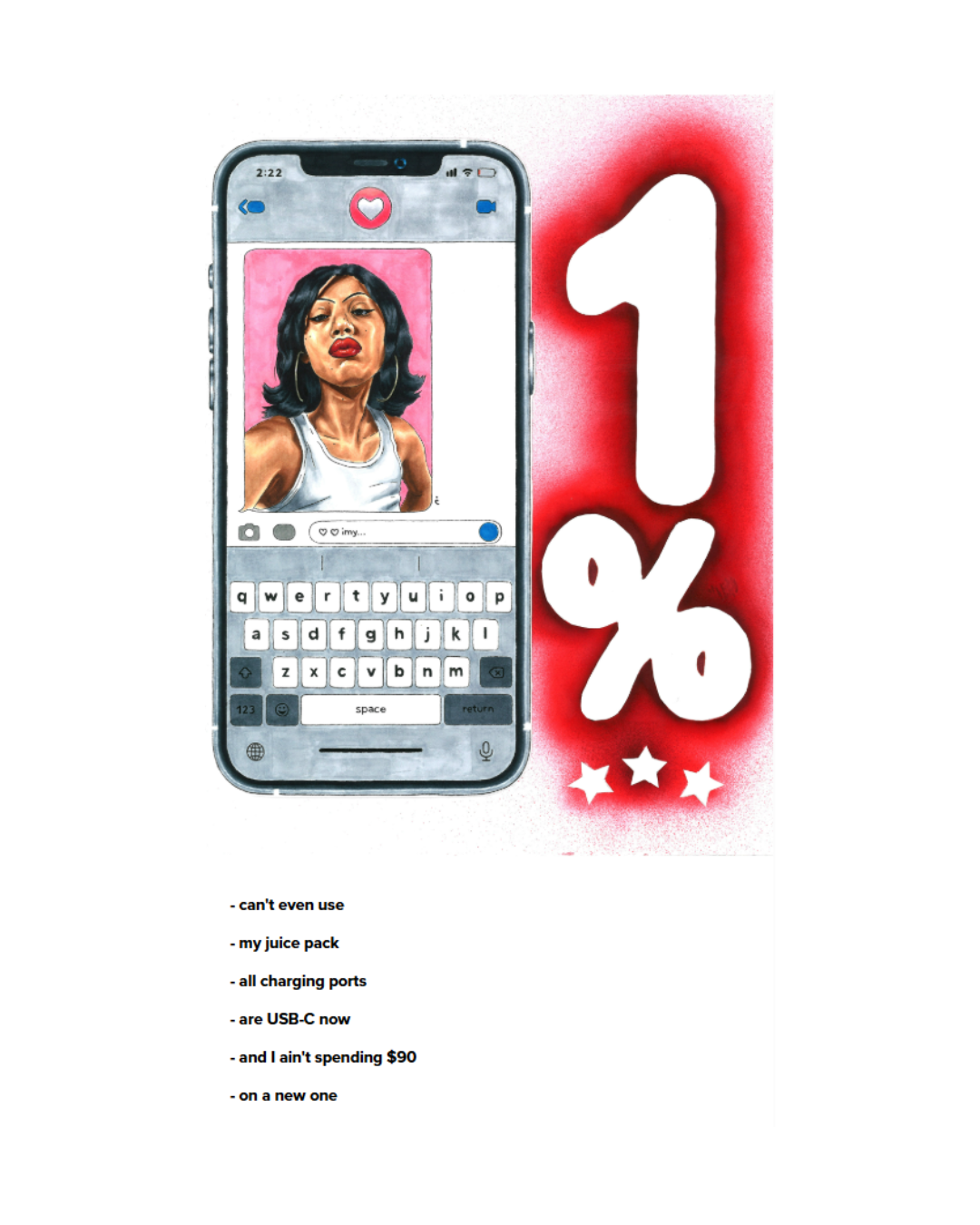
1% and i miss u (2020) [with short reflection near the bottom]
Q: Speaking of still lifes, your piece Martinellis and Sangria from 2020 seems to be one of your most recognized works. Why do you think that particular piece resonated with so many people?
IC:
Oh man, that’s a great question because I honestly have no idea.
There’s a whole story behind that drawing that I could talk about forever, but there are definitely some repressed memories that come with it.
But the point being, I remember while I was working on that drawing, I was sharing progress photos of it on Twitter.
It started with the line art. I just posted it, and keep in mind, back then I only had around 500 followers. It was mostly friends, homies from school, and a couple online homies.
I was just sharing it because I wanted my friends to see what I was working on.
Then once I started adding color, even from the beginning, I didn’t think it was going to end up being what it turned into.
My original approach was like, “Oh, I’m just going to add some shading and make it look kind of flat.”
But I just felt compelled to really go all in and push myself to see how close I could get to rendering it to its actual likeness.
So I kept sharing progress photos, and that’s kind of how my Twitter following started blowing up a bit.
People were seeing the updates and saying, “Holy shit, this looks so good. I can’t believe this is a drawing you’re working on.”
A lot of the comments I got were people talking about growing up and buying this apple juice because it had such a distinct look.
People remembered their first time buying it as a kid, enjoying the packaging, and how it looked like an actual apple.
It’s such a recognizable beverage.
I never realized something that simple could hold that much nostalgia for people.
A lot of people were sharing their own memories with that drink, and that’s something I never expected.
Once I shared the final thing, that’s when it really skyrocketed.
It transcended my friend group, my little circle, and reached its own space on the internet where everyone was seeing it.
It got reposted by big Instagram accounts.
Unfortunately, I didn’t get tagged or credited, but that’s kind of when I knew it took on a life of its own.
It’s cool seeing that people felt some sort of connection to it because I really didn’t anticipate that.
It definitely had its moment.
Honestly, it’s a very pivotal point in my history as an artist.
As much as I’ve kind of outgrown the sentiment behind that piece, it’s one that I can’t brush over or ignore.
It’s the elephant in the room when it comes to me and my personal upbringing as an artist.
Q: I feel like creating art is inherently vulnerable. You’re putting something personal out into the world and inviting other people to experience it. What goes through your mind when you release a new piece?
IC:
When I release a new piece, it’s kind of just like, “Hey, here’s something I spent X amount of hours working on, and I’m proud of it, so now I’m sharing it with you guys to look at.”
I really just treat it as a personal archive of my work.
Honestly, there’s no real crazy thought behind it.
I feel like I’ve always been desensitized to it.
I’ve always just been the type of person to say, “Here’s something I worked on. I’m going to share it.”
Then I just let it have its own life online.
I’ve had people ask me, “Dude, how do you overcome that fear of people seeing your work and seeing something so intimate?”
And when people ask me that, I’m kind of like, “I didn’t even know I was supposed to give it any thought.”
It’s really just a matter of putting in the time to make something that I think looks decent, and then wanting to share it with everyone else.
Q: Do you ever feel pressure to outdo yourself with each new piece?
IC:
I wouldn’t say with each new piece, but there are definitely occasions where I feel like I need to push myself and bring another step into my evolution and growth as an artist.
Like I mentioned earlier, I take every piece as a new learning experience.
With every drawing, whether it’s a personal one, something I’m going to post, or even a commission, I always tell myself:
“I want to learn at least one new thing going into this.”
Maybe it’s a different shading technique.
Maybe it’s using a different medium.
Maybe it’s trying a different masking technique to help with precision.
Things like that.
So I wouldn’t say it’s necessarily pressure to one-up myself.
It’s more about wanting to grow as an artist and pursuing that growth through different experiments.
It’s a matter of:
“I know how to use this thing. Now let me see how far I can take it.”
Every new drawing is one step further in that journey.
Q: Looking at everything you’ve created so far, what are you most proud of? Is there a specific piece, exhibit, or opportunity that stands out to you? I saw that one of your pieces was featured in the Los Angeles Times.
IC:
Yeah, I would definitely say the Los Angeles Times was a really cool placement.
That happened quite literally overnight.
Someone who worked for one of their editorials reached out to me and said, “Hey, we have this article about the cultural significance of Dragon Ball Z, Goku, and Mexican culture.”
They wanted me to create something that illustrated that significance.
So I came up with a pretty cool idea and concept.
The only thing was that they quite literally wanted it done by the next day.
So I had to pull a crazy all-nighter to get it done.
But I feel like it paid off.
That’s definitely something cool to have on my resume and say, “Yeah, I got to do something for the Los Angeles Times.”
That was a pretty cool opportunity.
Other than that, I’ve done a lot of work with up-and-coming streetwear brands.
These are people that I’ve become good friends with over time.
Getting to have my work on T-shirts, posters, and things like that is always pretty cool.
And when it comes to exhibits, it’s always kind of hit or miss with LA exhibits.
But one space where I can say I had a great time displaying work was Garage Space in North Hollywood.
My friend Mike was running it, and I displayed work there a couple times.
It was just a great flow of artwork, the exhibit, and the space for people to hang out.
Those events are definitely some of the highlights that I look back on fondly.
Any opportunity is a great opportunity, but those are definitely the ones that stand out the most for me.
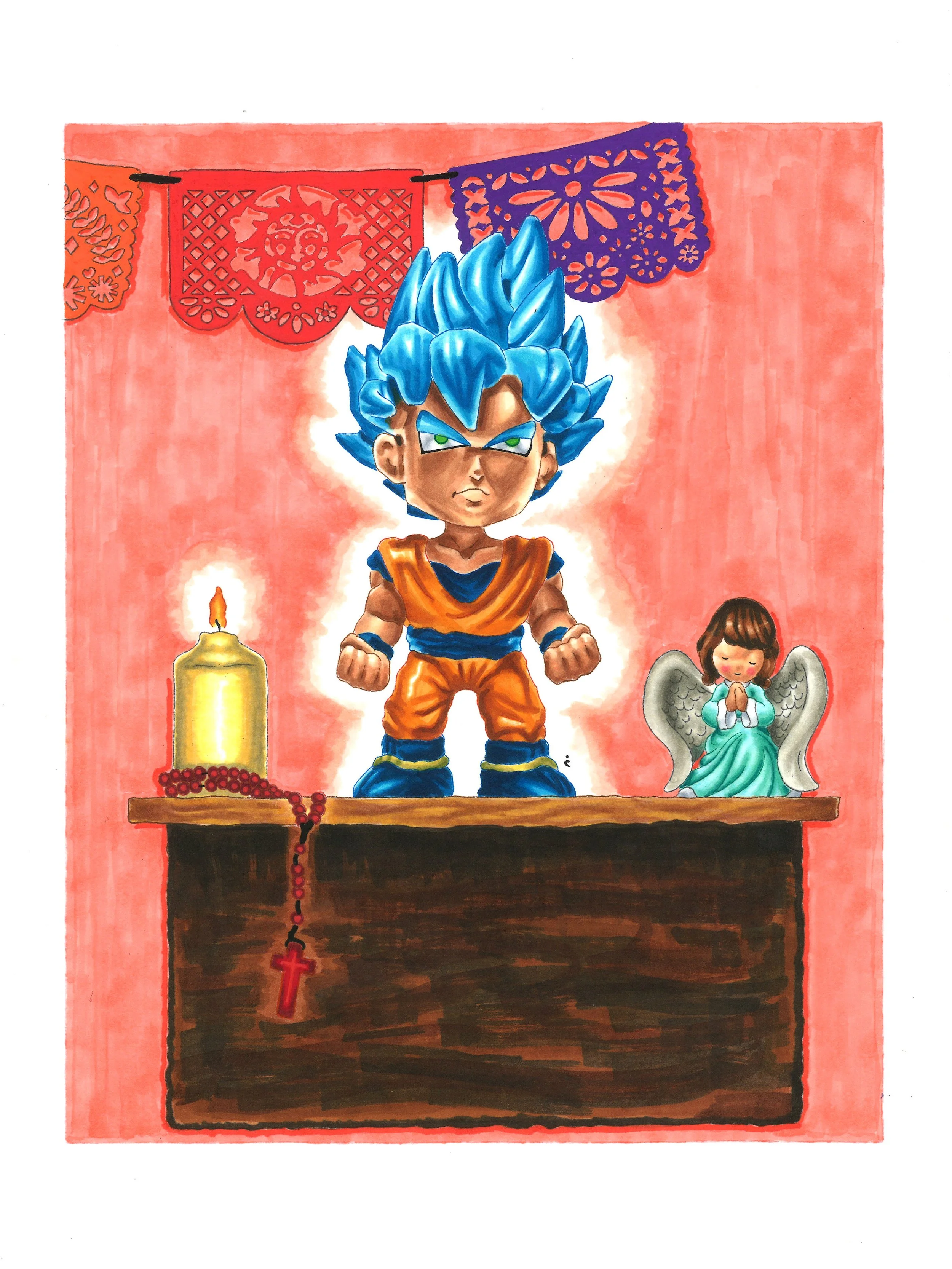
St. Goku (2023), Commission Piece for the Los Angeles Times
Q: I want to get into the philosophy of art for a second. I think an artist’s social function is that they’re almost a prophetic figure in society. They reflect their time and culture, and whether they realize it or not, they’re telling a broader story about the world around them. That’s what separates a good artist from a great artist.
Q: Since so many people resonate with what you create, how does it feel knowing that by simply catering to your own creativity, your work has touched other people?
IC:
It feels great, honestly.
It’s one of those things that, unfortunately, I overlook a lot of the time.
But I do have moments where I sit down and reflect, and I just think, “Wow, I never would have imagined that my art would ever make it out of my room.”
I wish I could tell myself back in sixth grade:
“Dude, these little drawings you’re doing? One day it’s going to be more than just your cousins seeing this. It’s more than just your classmates seeing this. There’s a whole world out there.”
Honestly, I feel very honored.
The fact that people from all over have seen my work and can appreciate it and resonate with it is a blessing.
It’s very overwhelming when I really think about it, but in the best way possible.
I keep saying it, but I’m honestly just very honored and grateful that my work has touched so many eyes out there.
Q: What are your favorite art mediums?
IC:
A thousand percent, Copic markers.
They’re alcohol-based markers that I’ve been using religiously since I really started taking my work seriously in 2018.
That was the year I bought my first set of markers.
Thankfully, I had a good amount of financial aid money that helped me afford them.
I had some friends in high school who worked with them, so I knew they were pretty pricey, but I also knew how good the quality was.
It’s funny because now people ask me how they can get into those kinds of markers, and I always recommend going for cheaper alternatives first just because of the cost.
It’s kind of crazy that I jumped straight into the top of the top.
But I actually took it seriously.
It wasn’t something I bought just to have lying around and mess around with.
I really wanted to learn and grow with these markers.
So I’ve been using them, like I said, almost religiously for eight years.
I say almost because recently I started implementing colored pencil into my work, and that kind of unlocked a whole new world.
A whole new world of shading, blending, and coloring.
Things I could achieve with markers, but with a lot more work.
With colored pencil, it makes the process feel more seamless and streamlined.
So I’d say those two are definitely my top mediums right now: colored pencil and Copic markers.
I’ve dabbled with Posca paint markers, acrylic paint, oil paint, but they definitely have their time and place.
They’re just not what I would preferably work with.
My bread and butter is definitely Copic markers and colored pencil.
